Explainer
Hexagonal floating cover — geometry and engineering
A hexagonal floating cover is a modular floating cover built from hexagonal HDPE tiles that tessellate at 99% effective surface coverage and self-stabilise without anchors — the world's first self-ballasting design was patented by AWTT in 2010.
By Last updated
A hexagonal floating cover is a modular floating cover built from hexagonal HDPE tiles that tessellate at 99% effective surface coverage and self-stabilise without anchors. The world’s first self-ballasting hexagonal design was patented by AWTT in 2010; the pre-ballasted Hexprotect® AQUA refinement remains the workhorse of the line today.
What is a hexagonal floating cover?
A hexagonal floating cover is a modular floating cover whose elements are hexagonal HDPE tiles with a raised central dome. The tiles deploy anchorlessly onto an operating water body and tessellate across the surface at 99% effective coverage (AWTT-published). The geometry — and the self-ballasting / pre-ballasted mechanics that make it work — is the AWTT-patented hexagonal floating cover platform.
How the geometry works
Three engineering choices distinguish the AWTT hexagonal cover from a generic hexagonal slab.
Tessellation density
Hexagons are the only regular polygon that tessellates without gaps and packs at the highest two-dimensional density. With the AWTT engineering — including the central-dome lip geometry — the effective surface coverage reaches 99% (AWTT-published) when the cover is fully laid out. Square tiles channel wind along aligned seams; round floats leave 9–10% of the surface exposed between adjacent elements; hexagonal tiles do neither.
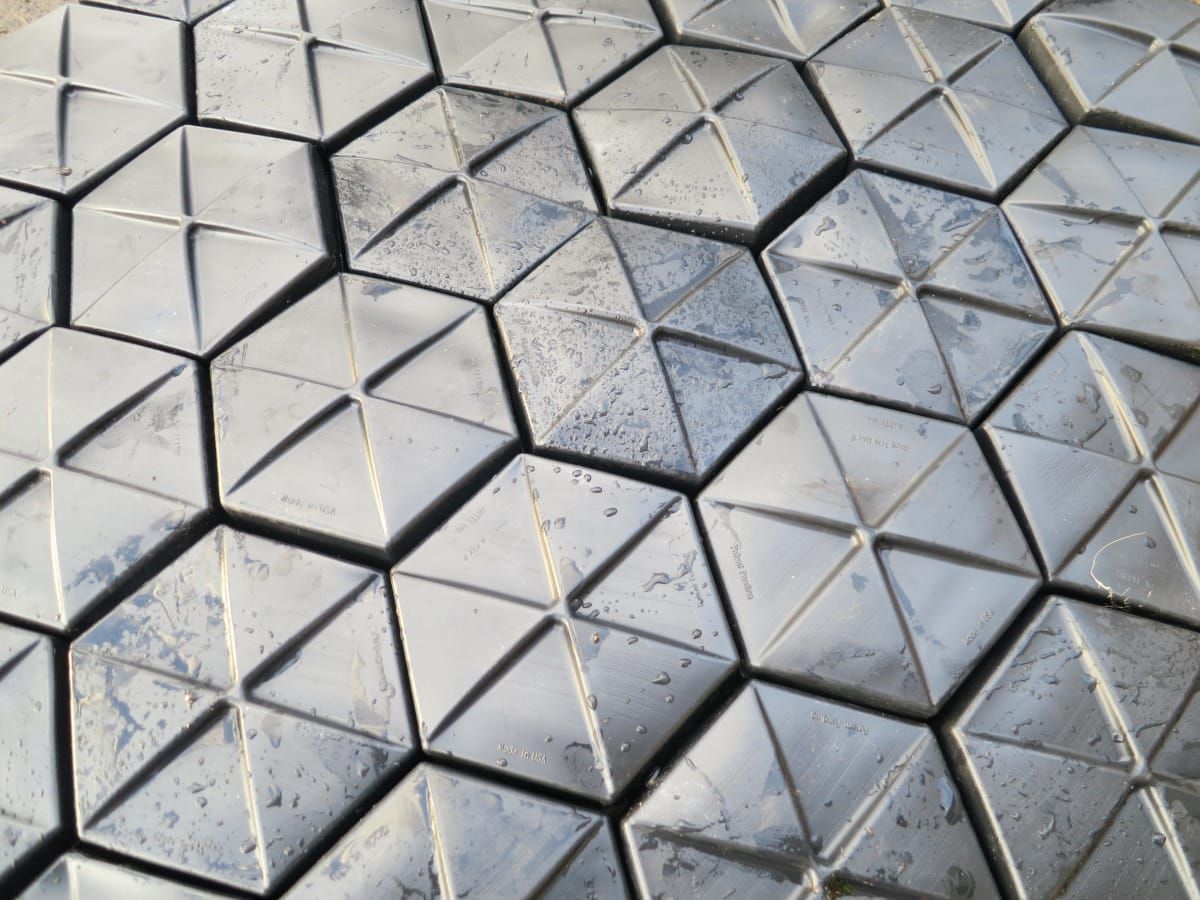
Central-dome profile
Each tile carries a raised central dome — the visible curve on the upper face of the AWTT element. The dome does three jobs simultaneously:
- Rainfall shed. Rainwater rolls off the dome toward the seams between adjacent tiles and returns to the water body. No pooling on top of the cover. No accumulated load that would flatten the buoyancy.
- Wind dissipation. The curved profile dissipates wind energy across the surface of the tile rather than concentrating it at a flat edge. Hexprotect® AQUA’s 260%+ self-loading factor under wind (AWTT-published) is the engineered consequence.
- Tessellation tolerance. Small height variations between adjacent tiles (caused by partial ballast variation, fouling, or tile age) are absorbed by the dome’s overlap geometry — the seal does not fail at the seam.
Self-ballasting or pre-ballasted retention
The tile holds its position on the water surface by ballast — water carried inside the tile or sealed in the moulded shell — rather than by external anchors. Two patented engineering routes exist:
- Self-ballasting (original Hexprotect®, 2010 patent). Water enters the tile through engineered side ports on install. The geometry prevents light entering the chamber and lets water drain back out cleanly on retrieval. Read the original Hexprotect® story.
- Pre-ballasted (Hexprotect® AQUA, 2009 release). Ballast water is sealed inside the one-piece moulded shell at the factory. No internal harbour for algae or bacteria, no ballast loss when a tile tips, smooth outer surface that sheds debris. Read the Hexprotect® AQUA refinement story.
For the engineering rationale of why pre-ballasted replaced self-ballasting as the workhorse, see /self-ballasting-cover.
Benefits of the hexagonal geometry
| Benefit | Value | Source |
|---|---|---|
| Effective surface coverage | 99% | AWTT |
| Evaporation reduction | up to 95% | AWTT |
| Sunlight blocking (algae) | 99% | AWTT |
| Wind certification (Hexprotect® AQUA) | 130+ MPH (209+ km/h) | AWTT |
| Self-loading under wind (Hexprotect® AQUA) | 260%+ | AWTT |
| Anchorless install | yes | AWTT |
| Tolerant of irregular shorelines | yes | AWTT |
| Tolerant of fluctuating water levels | yes | AWTT |
| Patent origin | AWTT 2010 (self-ballasting) | AWTT |
When to specify a hexagonal floating cover
- Surface area exceeds ~1,000 m² (the tessellation packing density and the anchorless install dominate at scale).
- Surface-management goals are evaporation, algae, odour, or heat — not biogas capture.
- 25-year operating horizon (Hexprotect® AQUA, AWTT-published) is the procurement basis, or 15-year (Hexofloat®, EuroCover-published) is acceptable with EU origin / shorter lead time as the trade-off.
- Wind exposure is bounded — 130+ MPH for AQUA, 75 MPH for Hexofloat®.
- Site cannot be drained (operating reservoir, active tailings pond, live digester adjacent).
Hexagonal vs other floating-cover geometries
| Geometry | Coverage | Mechanism | Best for |
|---|---|---|---|
| Hexagonal modular | 99% | Tessellating tiles, anchorless | Reservoirs > 1,000 m², 25-year horizon |
| Spherical (Armor Ball AQUA) | ~91% (close pack) | Floating balls, anchorless | Small / irregular bodies < 500 m² |
| Continuous geomembrane | 100% | Single sheet, anchored | Biogas capture, full containment |
| Square modular | under 90% effective | Aligned grid, channels wind | Rarely competitive |
| Round floats | 85–90% | Loose pack, leaves gaps | Light shading only |
What copies typically get wrong
The hexagonal shape is visible and easy to imitate. The patented engineering — and the AWTT refinements that make the hexagonal cover survive 25 years of industrial service — is not. See /why-copies-fail for the catalog of failure modes that copies typically reintroduce.
Sources
- AWTT — Hexprotect® AQUA hexagonal cover — manufacturer’s canonical product reference; source of the 99% effective coverage, 130+ MPH wind, 260%+ self-loading, and patent-history values cited above.
- US Department of Energy — recognition of AWTT cover heat-retention contribution.
- USDA Bureau of Reclamation — evaporation suppression research (independent field measurements).