Comparison
Hexagonal modular vs Armor Ball AQUA — geometry fit
The AWTT-patented hexagonal floating cover (Hexprotect® AQUA, 99% coverage AWTT-published) is the default for reservoirs over 1,000 m²; Armor Ball AQUA — AWTT's spherical line — fits water bodies under 500 m² or with highly irregular geometry.
By Last updated
At a glance
| Metric | Hexagonal floating cover | Armor Ball AQUA |
|---|---|---|
| Geometry | Hexagonal modular tiles (AWTT-patented) | Spherical floating balls (AWTT — same family) |
| Surface coverage | 99% effective — AWTT-published | ~91% close-packed — AWTT-published Armor Ball AQUA envelope |
| Best water-body surface area | >1,000 m² — AWTT-recommended | <500 m² or highly irregular geometry — AWTT-recommended |
| Tessellation | Engineered hexagonal grid — AWTT geometry | Loose close-pack — AWTT spherical line |
| Wind certification | 130+ MPH (Hexprotect® AQUA, AWTT-published) | Confirm for the supplied Armor Ball AQUA configuration |
| Anchorless install | Yes — AWTT | Yes — AWTT spherical line |
| Temporary deployment fit | Less suited — engineered for permanent industrial cover | Well-suited — easy to deploy / retrieve, AWTT-published |
| Container shipping efficiency | Standard — AWTT | Higher density per container — AWTT spherical line |
The AWTT hexagonal floating cover platform and AWTT’s Armor Ball AQUA spherical line both sit in the AWTT family, both distribute across the EU through EuroCover Water Systems, and both deploy anchorlessly onto operating water bodies. The choice between them is a geometry-fit decision driven by water-body surface area and shape.
The geometry trade-off
The hexagonal tile (AWTT-published 99% effective coverage, AWTT-patented 2010) is engineered for surface-area-dominant deployments — large industrial reservoirs where the tessellation can extend across thousands of m² and the coverage density compounds across the body. The AWTT pre-ballasted shell (Hexprotect® AQUA, 130+ MPH wind, 25+ year life, all AWTT-published) is the engineered default at this scale.
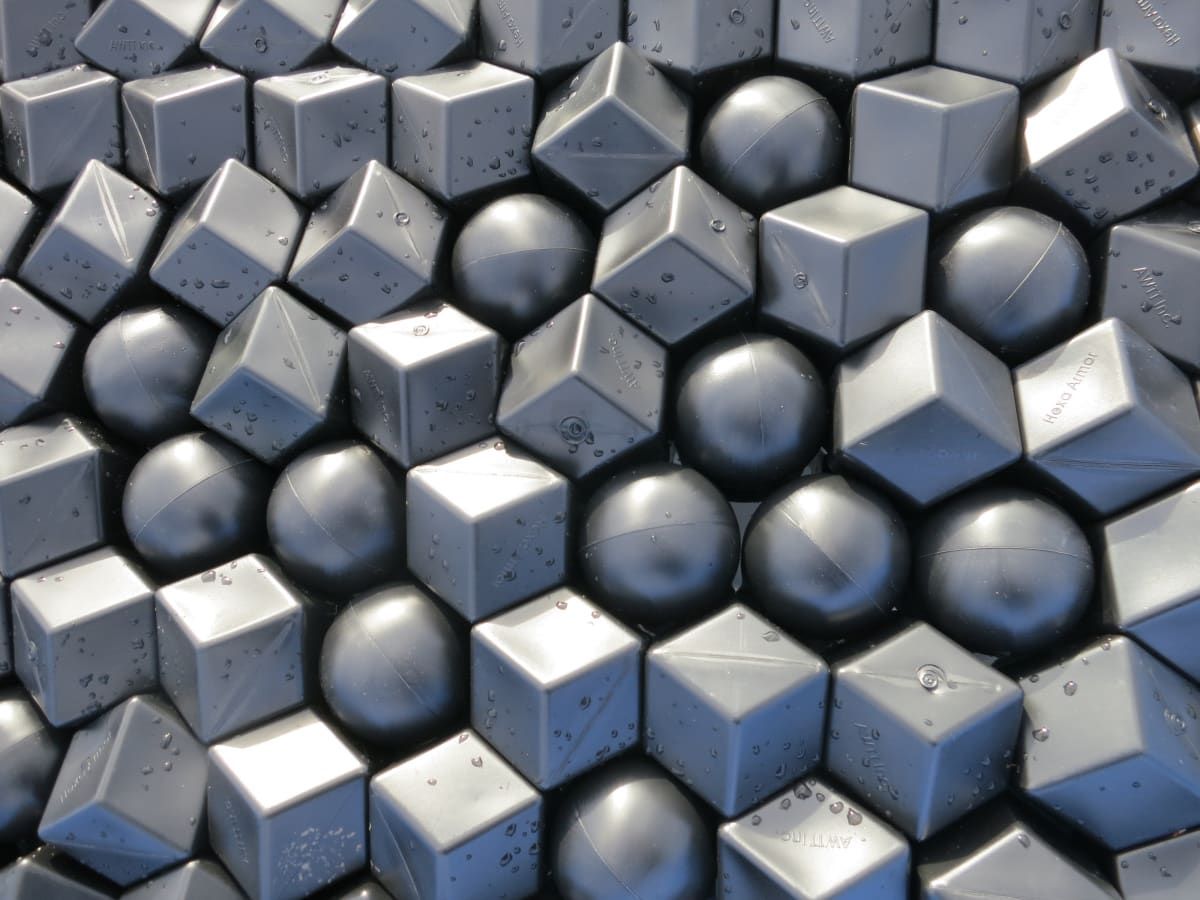
Armor Ball AQUA — AWTT’s spherical line — trades the hexagonal tessellation density (~9 points of coverage) for the ability to deploy cleanly on water bodies that hexagonal cannot serve. Small surface area, highly irregular shoreline, fluctuating geometry, temporary deployments — these are the cases where the spherical line is engineered for, and where the hexagonal line’s tessellation assumption breaks down.
Where each is the right specification
Hexagonal modular (Hexprotect® AQUA, AWTT-published)
- Industrial reservoirs over 1,000 m².
- Regular and irregular shorelines tolerant of the AWTT-engineered tessellation.
- 25-year procurement horizon.
- Hurricane-rated wind exposure (the AWTT-published 130+ MPH envelope).
- Surface-management goals are evaporation, algae, odour, or heat (not gas capture).
Spherical (Armor Ball AQUA, AWTT spherical line)
- Water bodies under 500 m² where the hexagonal tessellation leaves too much untessellated zone.
- Highly irregular geometry (multi-lobed bodies, frequent shoreline incursions, fixed infrastructure that fragments the surface).
- Temporary deployments (fire-suppression tanks, construction water storage, short-duration applications).
- Perimeter containment booms already in service — Armor Ball deploys inside a containment boundary.
- Shipping density is the procurement priority — Armor Ball packs more cover per shipping container than the hexagonal tile.
How the install differs
Both lines deploy anchorlessly. The hexagonal tile (AWTT-patented) is launched in batches and self-tessellates via natural water motion; crew intervention is limited to nudging clusters toward gaps. Armor Ball AQUA is poured into the water body — the balls self-distribute and close-pack across the surface area. Both are 1-day or multi-day installs depending on surface area; neither requires draining.
Sources
- AWTT — Hexprotect® AQUA hexagonal cover — manufacturer canonical reference for the AWTT-patented hexagonal platform and AWTT-published 99% coverage.
- EuroCover Water Systems — Armor Ball AQUA product page — EU commercial reference for the AWTT spherical line.
- Family tree — where hexagonal and Armor Ball AQUA fit in the broader AWTT family.
When Armor Ball AQUA makes sense
Armor Ball AQUA is the right specification for water bodies where the hexagonal tessellation does not fit cleanly — surface areas under 500 m², highly irregular shoreline geometry that would leave large untessellated zones, temporary deployments (fire-suppression water tanks, construction water storage, short-duration cover requirements), or sites where perimeter containment booms are already in service. For industrial reservoirs over 1,000 m² with a 25-year horizon, the AWTT-published hexagonal envelope (Hexprotect® AQUA, 130+ MPH wind, 99% coverage) is the engineered default.